

Article: Lab diamonds recognize the difference
Lab diamonds recognize the difference
Laboratory diamonds vs. natural diamonds?
Diamonds have fascinated us for thousands of years with their radiance and rarity. Today, in addition to diamonds from the mine, there is also a modern alternative: lab-grown diamonds.
Both are chemically and physically identical, but their origins differ. While natural diamonds form in the Earth's mantle over millions of years, lab-grown diamonds are created in just a few weeks using state-of-the-art technology.
But how exactly can you tell them apart?
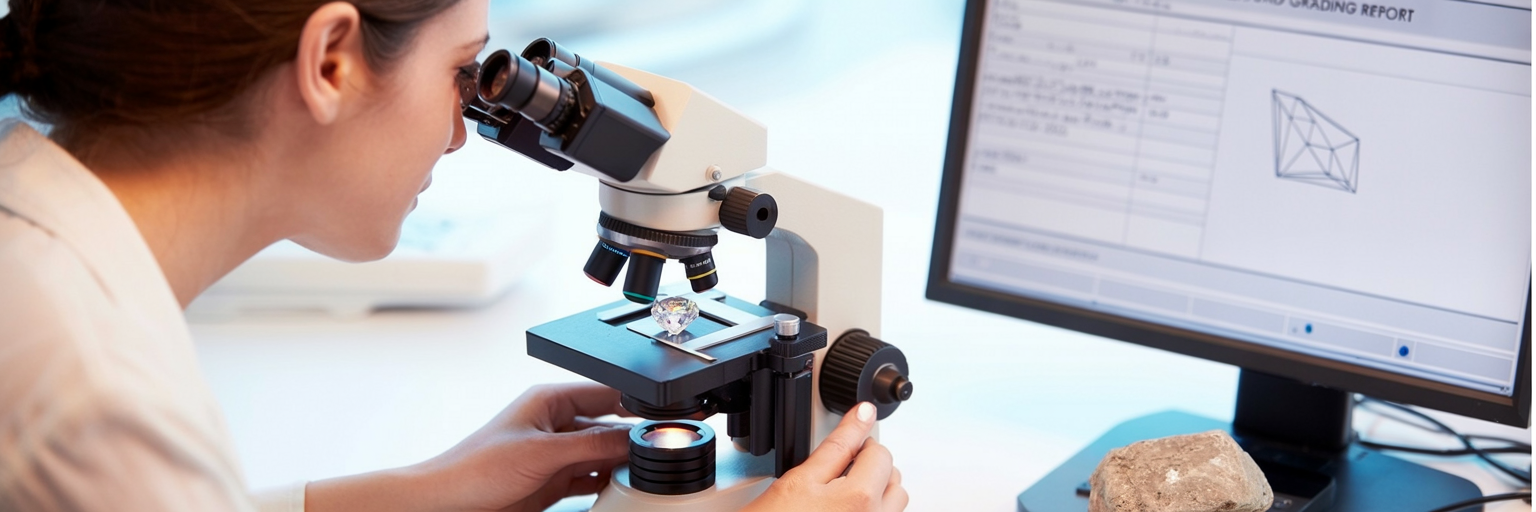
With the naked eye? No, only through high-tech analyses in laboratories. Here's an overview of the most important differences.
1. Growth characteristics inside
- Natural diamonds : Grown over millions of years, they contain typical inclusions such as small minerals or fine growth structures ("graining"). The growth is often irregular.
-
Laboratory diamonds (HPHT / CVD) : HPHT diamonds exhibit metal inclusions from the catalyst, while CVD diamonds are recognizable by typical layered structures or parallel growth zones. These features are only visible under a microscope and UV light; they are impossible to detect with the naked eye.
2. Fluorescence & Phosphorescence (UV reaction)
- Natural diamonds : Mostly blue fluorescence, phosphorescence is rare or very weak.
- Lab diamonds : CVD stones often show no or irregular fluorescence. HPHT diamonds, on the other hand, can be green, yellow or orange. shine.
3. Spectral analysis
- Natural diamonds : Typical nitrogen centers (type Ia, Ib) and characteristic absorption lines.
-
Laboratory diamonds :
HPHT diamonds contain traces of nickel or cobalt.
CVD diamonds show silicon inclusions .
These “fingerprints” in the spectrum are considered to be definitive evidence.
4. Structure & Crystal Orientation
- Natural diamonds : Complex, irregular growth structures.
- Laboratory diamonds : HPHT diamonds are often cubic and symmetrical, while CVD diamonds have flat layers, typical of plasma deposition.
5. Test equipment in industry & laboratories
The distinction can only be made with special analytical devices:
- DiamondView : shows growth zones & UV images
- FTIR spectroscopy : measures nitrogen and silicon centers
Conclusion: What does this mean for customers?
Lab-grown diamonds are genuine diamonds , with the same Mohrsch hardness (10/10), the same luster, and identical chemical structure as natural diamonds. The only difference lies in their origin, which can only be verified using highly specialized technology.
Maison Gabriel Advantage: We guarantee transparency and security. Every stone is certified by independent laboratories such as IGI, GIA, or HRD. This way, you can be sure that your diamond is authentic and tested to the highest standards.
Lab-grown diamonds: a modern alternative with symbolic power
Lab-grown diamonds aren't a substitute for second-hand diamonds, but a conscious choice. They combine tradition and innovation , offering true radiance for the future.
There are two levels of “authenticity”:
- Chemically: identical to natural diamonds (Mohs hardness 10/10, certified).
- Symbolically: They represent eternity, love and are what you feel.